Which Payments Made by Employers Must Be Included in Employees’ Personal Income Tax Returns in Thailand?
Written by the team at Prompt Plus Accounting · About us ·
Are all payments made by employers, including salaries, bonuses, severance pay, meal allowances, and travel allowances, subject to personal income tax? Explore the relevant tax rules, exemptions, and practical examples of employee income and benefits. Learn how companies and employees can ensure accurate personal income tax reporting in Thailand.
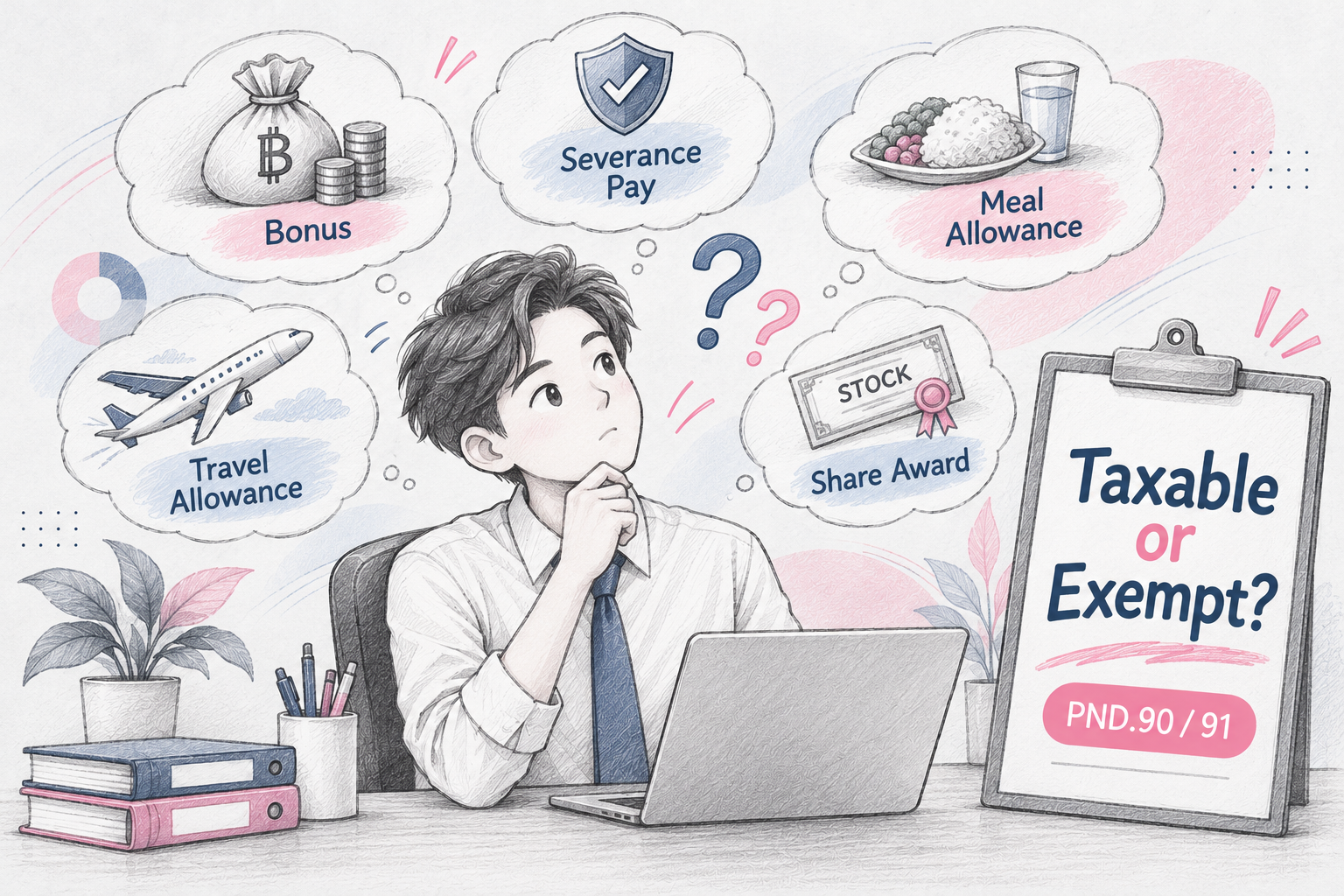
Understanding Severance Pay, Bonuses, Share Awards, Daily Meal Allowances, Travel Allowances, and Business Travel Expenses
When it comes to filing an annual personal income tax return in Thailand, one common question raised by employees, accounting departments, and HR teams is whether all payments and benefits received from an employer must be included as taxable income in the employee’s Personal Income Tax Return (PND.90 or PND.91).
In addition to regular salaries, companies may provide employees with various forms of compensation and benefits, such as annual bonuses, severance pay, daily meal allowances, travel allowances, or even company shares.
However, these payments and benefits are subject to different tax treatments under Thai tax law.
The key principle is that not every payment made by an employer to an employee is automatically subject to personal income tax. The tax treatment depends on the nature of the payment, its purpose, and whether it represents compensation or a reimbursement of expenses incurred on behalf of the employer.
This article explains the tax treatment of common employee payments and benefits, together with practical examples.
1. General Principles of Employee Taxable Income
Under Section 40(1) of the Thai Revenue Code, income derived from employment is classified as assessable income. Examples include:
- Salaries and wages
- Bonuses and allowances
- Pensions and gratuities
- Housing allowances paid by employers
- Other monetary or non-monetary benefits received in connection with employment
Therefore, employment income may include not only cash payments but also benefits or privileges that can be valued in monetary terms.
However, certain payments and benefits may qualify for tax exemptions under specific provisions of Thai tax law. As a result, not all amounts received by employees must necessarily be included in taxable income.
2. Is Severance Pay Received Upon Termination of Employment Taxable?
When an employer terminates an employee and pays statutory severance pay under Thai labor law, such payment is generally considered income derived from employment.
However, Thai tax law provides a partial exemption for qualifying statutory severance payments.
Tax exemption criteria
Under Ministerial Regulation No. 394 (B.E. 2567), statutory severance pay received due to involuntary termination of employment, excluding retirement or the expiration of an employment contract, is exempt from personal income tax up to the lower of:
The employee’s wages for the final 400 days of employment; or THB 600,000.
Any excess amount must be considered for personal income tax purposes under the applicable tax rules.
Example
An employee earning a monthly salary of THB 30,000 is terminated and receives statutory severance pay of THB 500,000.
Wages for the final 400 days = THB 400,000
Maximum exemption limit = THB 600,000
Total severance pay received = THB 500,000
Therefore, THB 400,000 is exempt from personal income tax, while the remaining THB 100,000 must be considered for tax calculation.
Important note: Not all payments made upon termination automatically qualify for the exemption. It is necessary to distinguish statutory severance pay from additional compensation, special termination payments, or other benefits provided under employment agreements.
Certain payments received as a lump sum upon termination may also qualify for separate tax calculation under Section 48(5), provided the statutory conditions are met.
3. Are Employee Bonuses Subject to Personal Income Tax?
Bonuses are generally classified as employment income under Section 40(1) of the Thai Revenue Code.
This includes:
- Annual performance bonuses
- Profit-sharing bonuses
- Special bonuses
- Other incentive payments made by employers
Therefore, cash bonuses received by employees must generally be combined with salaries and other taxable employment income when calculating annual personal income tax.
What if the company awards shares as a bonus based on their par value? Should the par value or market value be used?
This situation must be distinguished between a cash bonus calculated based on a share's par value and an actual transfer of shares to an employee.
- Case 1: The company pays a cash bonus calculated using the par value of shares
If the company does not actually transfer shares to the employee but instead pays a cash bonus calculated based on the number of shares multiplied by their par value, the actual cash amount received is generally treated as employment income.
For example, a company calculates an employee's bonus based on 1,000 shares at a par value of THB 10 per share and pays the employee THB 10,000 in cash.
The employee must include THB 10,000 in taxable employment income. There is no need to recalculate the cash bonus using the market value of the shares.
- Case 2: The company actually grants shares to an employee free of charge or at a price below market value
In this case, the employee receives an economic benefit arising from employment. The value of that benefit must generally be included in assessable income when ownership of the shares is transferred.
Under Tax Ruling No. 28/2538 issued by the Taxation Committee, share valuation principles may include the following:
For shares listed on the Stock Exchange of Thailand that are not offered to the public, the average market price during the month in which ownership is transferred may be used.
For unlisted shares that are not offered to the public, the book value in the preceding accounting period may be used.
Therefore, using the par value alone is not necessarily an appropriate valuation method in every case. The actual share arrangement and applicable valuation rules must be considered.
4. Are Daily Meal Allowances of THB 100 Taxable?
Suppose a company provides employees with a meal allowance of THB 100 per working day.
The allowance is paid only on days when employees report to work. If an employee is absent, no meal allowance is paid.
Although the company may classify this payment as an employee welfare benefit, it is generally considered an additional employment benefit received by the employee.
The Thai Revenue Department has previously issued an interpretation under Letter No. Kor Kor 0702/3552 dated 8 May 2012, concerning meal welfare payments made to employees only on days they report to work. The interpretation treated such payments as additional employment income under Section 40(1).
Example
An employee works 22 days in one month and receives a meal allowance of THB 100 per day.
Total meal allowance = 22 × THB 100 = THB 2,200.
The employee must include THB 2,200 in employment income when calculating personal income tax.
Important: Paying a meal allowance only on actual working days does not automatically make the payment tax-exempt.
5. Are Travel Allowances for Domestic or Overseas Business Trips Taxable?
When employees are assigned to travel outside their normal workplace for business purposes, whether within Thailand or overseas, employers may provide daily travel allowances to cover meals and other necessary expenses.
For example, a company may establish a fixed daily allowance of THB 300 or THB 500 for employees traveling on business.
Does the employee need to include this travel allowance in taxable income?
The answer is: Not necessarily.
Under Section 42(1) of the Thai Revenue Code, travel allowances and transportation expenses paid by an employer may be exempt from personal income tax if they are paid honestly and are necessary specifically for the performance of employment duties, and the expenses are fully incurred for that purpose.
Example: The company provides a daily travel allowance of THB 500
A company assigns an employee to work in another province for three days and provides a daily travel allowance of THB 500.
Total travel allowance received = 3 × THB 500 = THB 1,500.
If the employee genuinely travels for business purposes and the allowance meets the relevant legal requirements, the THB 1,500 may qualify for tax exemption and does not need to be included in the employee's taxable employment income.
What if the company pays a fixed daily allowance without requiring receipts?
A company may establish a fixed daily travel allowance, such as THB 500 per day, without requiring employees to submit receipts for every meal or minor expense.
This does not automatically mean the allowance is taxable.
Under Revenue Department Instruction No. P.59/2538, if the travel allowance does not exceed the maximum rates prescribed for official government travel, whether domestic or overseas, the payment may be regarded as having been made honestly and entirely for necessary business expenses without requiring individual payment receipts as supporting evidence.
However, if the allowance exceeds the applicable government rate, the employee must provide evidence demonstrating that the entire amount was genuinely and necessarily spent for the performance of employment duties.
Without sufficient supporting evidence, only the portion within the applicable government rate may qualify for exemption.
Therefore, a daily allowance of THB 500 is not automatically tax-exempt in every situation. The applicable government rate and supporting documentation must be considered.
What documents should the company maintain?
To support the tax exemption, companies should maintain appropriate supporting documents, such as:
- Travel authorization or an approved business travel order.
- Details of the destination and business purpose.
- Travel dates and duration.
- Evidence of travel allowance payments.
- Actual expense receipts or other supporting evidence where required.
Important: Simply labeling a payment as a "travel allowance" does not automatically qualify it for tax exemption.
If the company pays the allowance regularly without any actual business travel, or if the payment is an additional reward for employment rather than reimbursement of necessary business expenses, it may be treated as taxable employment income under Section 40(1).
6. Are Airfare, Accommodation, and Other Travel Expenses Paid Directly by the Company Taxable?
Another common question arises when a company directly pays for an employee's airfare, hotel accommodation, transportation, and other expenses related to business travel.
If the travel is genuinely undertaken for company business and the company directly books and pays for necessary expenses, such as:
- Airfare
- Hotel accommodation
- Airport transfers
- Domestic or overseas transportation
- Other expenses directly related to business activities
And the employee does not receive these payments as personal cash compensation or private benefits, such expenses would generally not be treated as the employee's personal taxable income.
Example
A company sends an employee to attend a business meeting with a client in Japan.
The company directly books and pays for the employee's airfare, hotel accommodation, and transportation.
These expenses are incurred for the company's business operations rather than providing personal income to the employee. Therefore, they would generally not need to be included in the employee's taxable income.
However, if the company also pays for personal expenses, such as airfare for the employee's family members or additional accommodation for a personal holiday, those expenses may be treated as taxable benefits received by the employee, depending on the circumstances.
7. Summary: Which Payments Must Be Included in Employees' Taxable Income?
Type of payment or benefit
Personal income tax treatment
- Salary and cash bonuses - Generally taxable
- Statutory severance pay - Partially exempt, subject to applicable conditions and limits
- Cash bonus calculated using share par value - Actual cash amount received is generally taxable
- Shares granted free of charge or below market value - Generally taxable based on the applicable share valuation rules
- Daily cash meal allowance - Generally taxable
- Business travel allowance - May be exempt if Section 42(1) conditions are met
- Additional payments unrelated to necessary business expenses - Generally taxable
- Airfare and accommodation paid directly by the company for business travel - Generally not treated as the employee's personal taxable income
- Personal expenses paid by the company on behalf of employees - May be taxable benefits
8. What Should Companies and Employees Prepare Before Filing Annual Tax Returns?
To ensure accurate personal income tax reporting, companies should review all payments and benefits provided to employees throughout the year, rather than considering only salaries processed through the payroll system.
The following items should be reviewed:
- Salaries, bonuses, and additional compensation.
- Employee welfare benefits and other employment-related benefits.
- Severance pay and other payments received upon termination.
- Shares or other benefits granted to employees.
- Daily meal allowances and regular allowances.
- Business travel expenses paid on behalf of employees.
- Travel approvals, receipts, and payment records.
Companies should also ensure that employment income and withholding tax information are properly recorded and reported so that employees can accurately prepare their annual Personal Income Tax Returns (PND.90/91).
Conclusion
Determining whether payments made by a company to its employees are subject to personal income tax does not depend solely on the name or description of the payment.
Instead, the purpose of the payment, its actual nature, and the benefits received by the employee must be considered.
Payments that represent compensation or benefits arising from employment are generally taxable. On the other hand, expenses incurred genuinely for the company's business activities may qualify for tax exemption or may not be treated as the employee's personal income, provided that the relevant legal requirements are satisfied and appropriate supporting documents are maintained.
Understanding these principles helps companies, accounting departments, HR teams, and employees ensure accurate payroll reporting, withholding tax certificates (50 Tawi), and annual personal income tax filings.
This article is general information, not advice for a specific case. Please consult us before making a decision.