What Must a Valid Tax Invoice Include?
Written by the team at Prompt Plus Accounting · About us · · Updated 2026-09-04
A tax invoice that's missing required details may not be usable to claim an input tax credit. Here's what a full-format tax invoice must include, and whether a signature is actually required.

A tax invoice is an important document that VAT-registered businesses must issue to customers every time they sell goods or provide a service. It's not just accounting evidence — it's also the document customers use to claim an input tax credit. If a tax invoice is missing details required by law, it may not be legally valid, affecting both the issuer and the recipient.
What Must a Full-Format Tax Invoice Include?
Under Section 86/4 of the Revenue Code, a full-format tax invoice must include at least the following details:
- The words "Tax Invoice" (ใบกำกับภาษี) displayed prominently
- The name, address, and taxpayer identification number of the registered business issuing the invoice
- The name and address of the buyer or service recipient
- The sequential number of the tax invoice, and the booklet number (if any)
- The name, type, category, quantity, and value of the goods or service
- The amount of VAT calculated on the value of the goods or service, shown clearly separate from the price of the goods or service
- The day, month, and year the tax invoice was issued
- A statement indicating "Head Office" or "Branch No. ...", matching the place of business registered for VAT
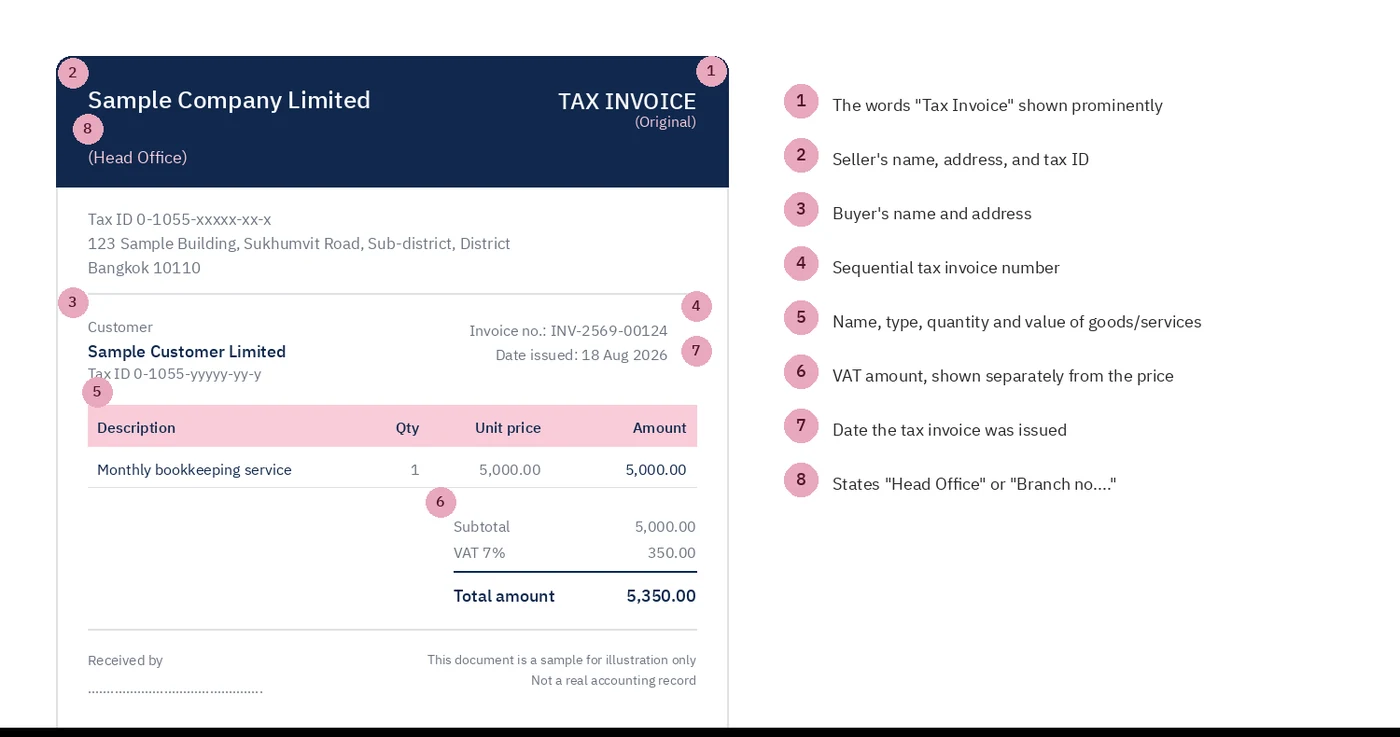
Why You Must State "Head Office" or "Branch No. ..."
Many people overlook this detail, assuming the company's name and address are enough. But under Notification of the Director-General of the Revenue Department on Value Added Tax (No. 199), businesses issuing a full-format tax invoice must state whether the place of business selling the goods or providing the service is the "Head Office" or "Branch No. ...", matching what appears on the VAT registration certificate, PP 20 (ภ.พ.20).
This requirement applies to both the seller and the buyer. In other words, if the customer is a company with multiple branches, its branch status should also be stated on the tax invoice, to keep the document fully compliant with the law.
How Does an Abbreviated Tax Invoice Differ from the Full Format?
For retail businesses or those serving a large volume of small transactions — restaurants and convenience stores, for example — the law allows issuing an "abbreviated tax invoice", which requires fewer details than the full format. However, this requires prior approval from the Revenue Department to use a cash register machine, and it cannot be used as evidence to claim a full input tax credit the way a full-format tax invoice can.
Does a Tax Invoice Need a Signature?
Many people believe a tax invoice needs the issuer's signature to be valid. In fact, the law does not make a signature a mandatory item. A tax invoice is legally complete as long as it contains all 8 items listed above, whether or not it's signed. That said, many businesses still prefer to have the responsible person sign, since it adds credibility and is useful for later verification.
Common Mistakes When Issuing Tax Invoices
- Stating an address for the issuer or buyer that doesn't match their VAT registration
- Forgetting to state whether the seller or buyer is the "Head Office" or "Branch No. ..."
- Not clearly separating the VAT amount from the price of the goods or service
- Issuing tax invoice numbers out of sequence, or duplicating them
- Forgetting to state the invoice date, or stating a date that doesn't match when the tax liability actually arose
Summary
A valid tax invoice is more than just a sales document — it's legal evidence that must contain every required item, including details that are often overlooked, such as head office or branch status. An incorrect or incomplete tax invoice can affect both your own tax filing and your customer's right to claim an input tax credit. Businesses should therefore regularly check that their tax invoice format is fully compliant with the law, or consult an accounting and tax professional to verify it before putting it into use.
This article is general information, not advice for a specific case. Please consult us before making a decision.